

Don’t let your job architecture become archi-torture
Build it and maintain it in JDX+. Create a coherent job architecture with workflows, versioning, and approvals that ensure bands, mobility, and defensibility.
Job architecture shouldn't be a one‑off project.
JDX+ helps you build a governed framework -- and keep it current -- as jobs change, markets move, and corporate strategy accelerates.
Help us protect and prioritize access.
This demo covers patent‑pending IP and high‑value methodology, so we ask for your name and email before sharing the video.
Job architecture builder: blueprint and framework setup
Blueprint + Framework.
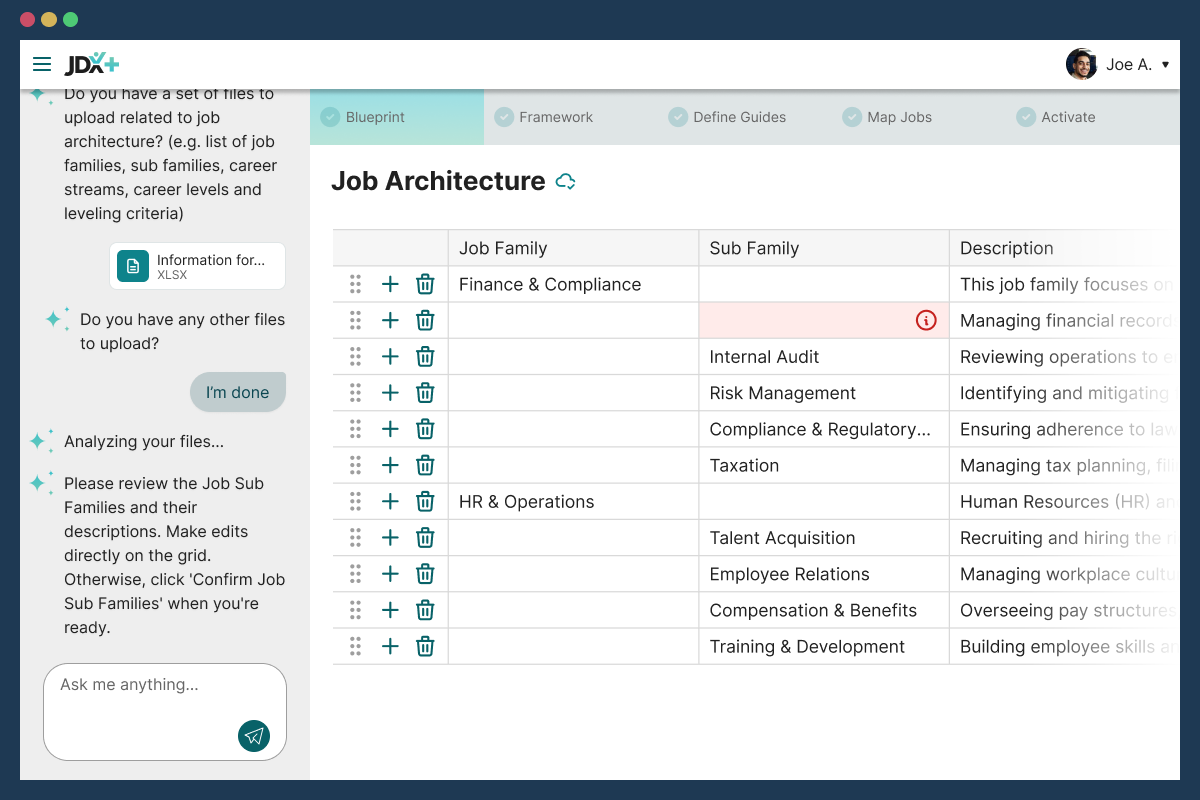
Start from what you already have (don’t throw it away). Upload your families, sub-families, career streams, and levels, or let JDX+ recommend a starting structure based on your job data. Then ‘stitch’ relationships so your framework is coherent, searchable, and ready to govern over time.
- Preserve prior investment
- Establish consistent framework
- Make relationships explicit
Job leveling software: create universal level guides
Universal level guides.
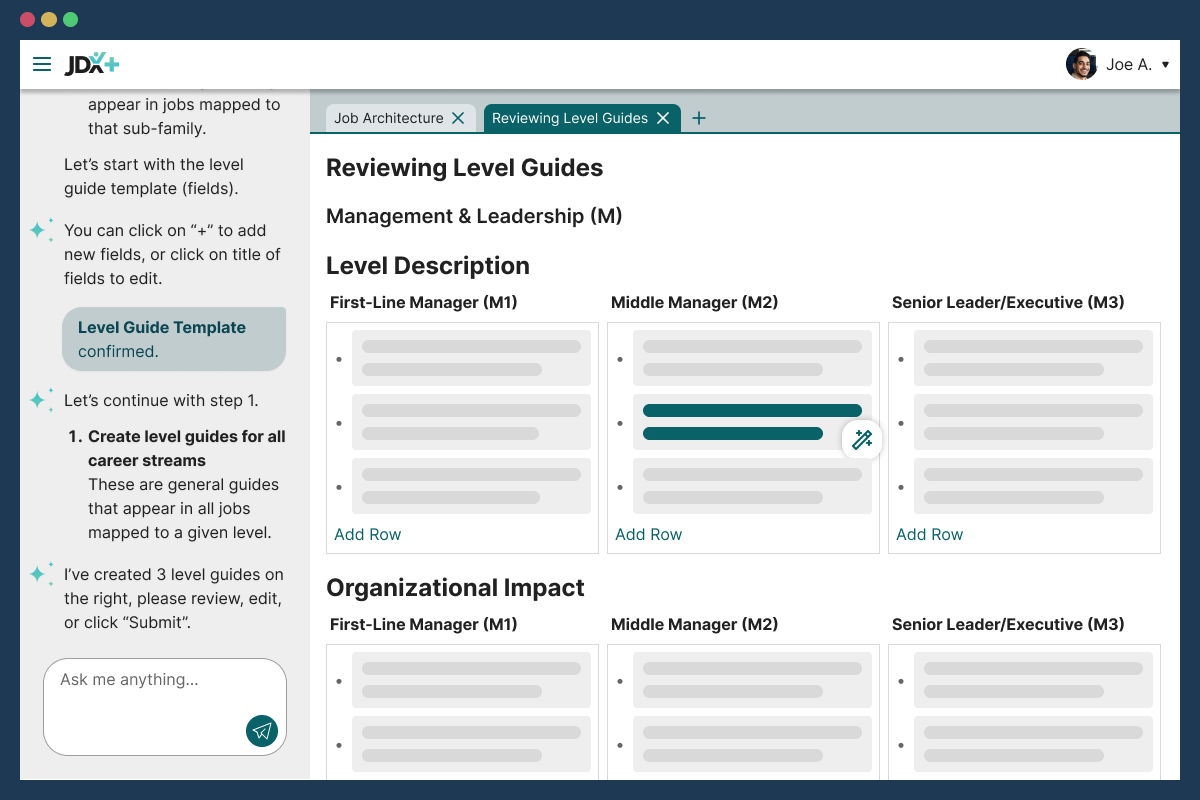
Create universal level guides across streams and levels with AI assistance, then refine with humans in the loop. AI helps fill the level guide fields for every level and career stream so you can standardize expectations, competencies, and skills by level without months of manual work.
- Standardize levels across the org
- Cut time spent on leveling
- One set of definitions across teams and levels
Job catalog mapping with confidence scoring
Map jobs with confidence scoring.
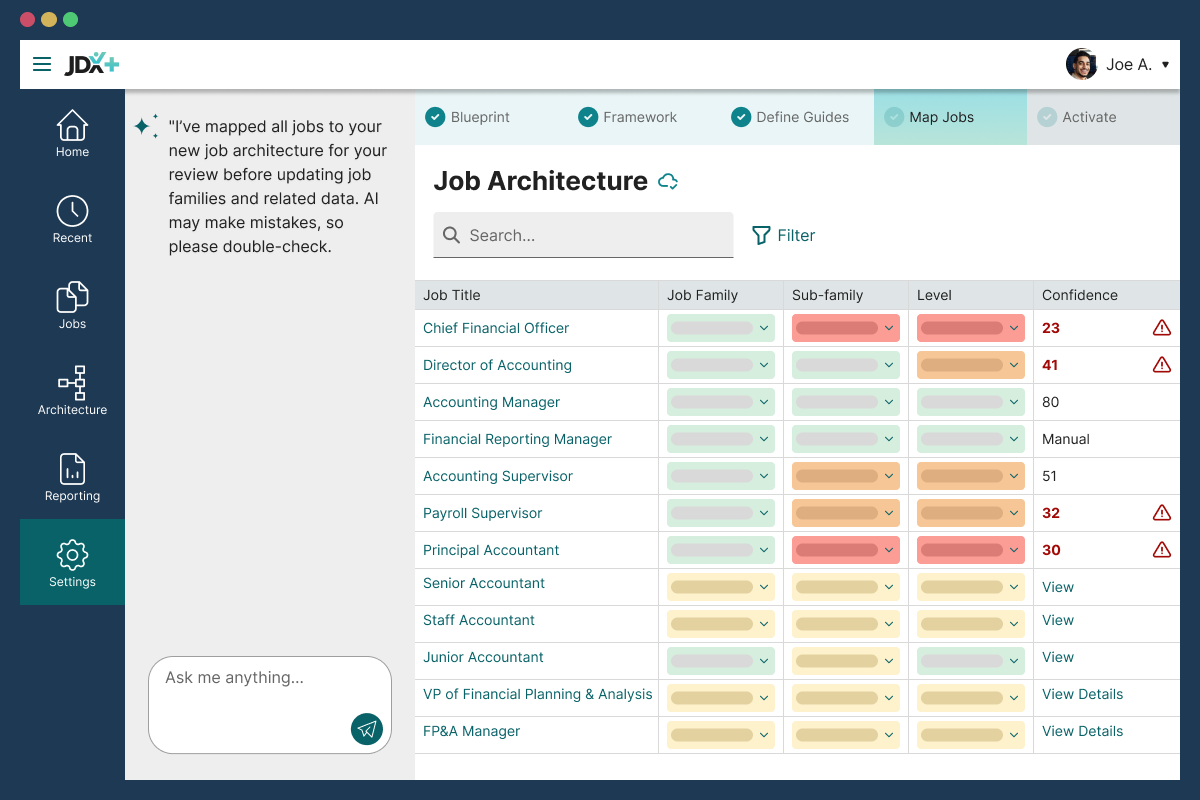
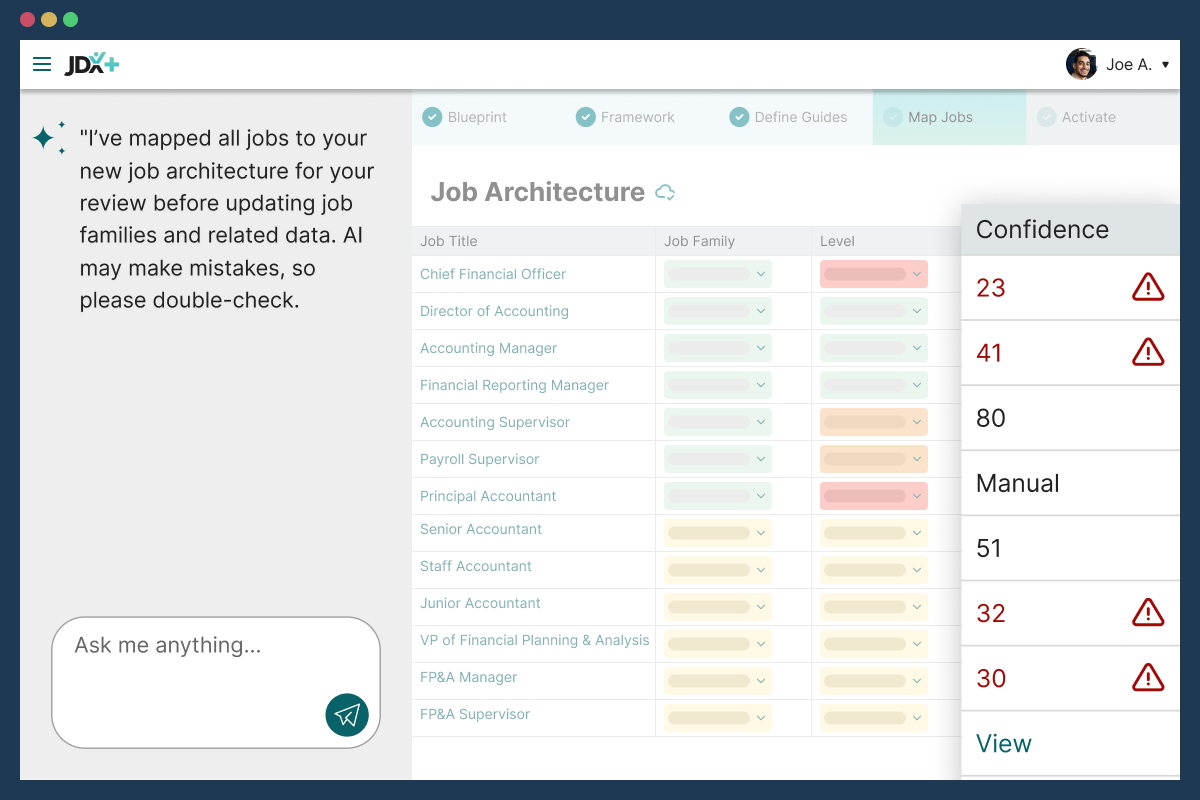
Map your jobs into your framework, then review only what needs attention. Confidence scoring highlights the low-confidence mappings so you can focus on exceptions, not thousands of jobs.
- Focus on exceptions
- Increase speed without sacrificing defensibility
- Ongoing mapping as new jobs appear
Frequently Asked Questions
-
Can we have different workflows for creating vs editing jobs, templates, architecture, acknowledgements?
Answer: Yes. You can run different workflows by activity (for example, create vs edit) and by governance object (jobs, templates, job architecture, acknowledgements). JDX+ includes out-of-the-box 2-stage and 3-stage workflows to start, and can expand to more activities and patterns as your governance program matures. We’re also enabling more self-service workflow configuration over time so you can add or remove stages depending on the activity.
-
How do we control who can be assigned at each step?
Answer: Assignments are role-based. Each stage/task requires a role, and only users with that role can be assigned and complete the work.
-
What channels do approvers use today and what's on the roadmap?
Answer: Notifications are delivered in-app and via email, with additional channels like Teams and Slack on the roadmap.
-
How does the audit trail support legal and compliance reviews?
Answer: Every edit, approval, and workflow action is captured in an audit trail, so you can quickly produce evidence for compliance and legal reviews (including exportable records).
-
Can workflows control when jobs are activated and sent to HRIS/ATS?
Answer: Yes. Jobs remain in draft until they complete the required approvals. Once approved and published, the approved job data can be synced to downstream systems (for example, HRIS and ATS), based on your integration method and cadence.
-
How do we handle exceptions, reassignments, and bulk changes?
Answer: Workflows are designed for real operations: clear ownership, tracked decisions, and auditable outcomes. If you have specific requirements for bulk changes or advanced exception handling, we’ll align on the best approach during implementation.
Build the framework. Keep it governed.
See how we build a job architecture in a weeks, not years.