

 Melissa Duncan, VP of People

Most employers can change job descriptions without employee agreement.
That's the short-and-sweet legal answer, but it's also incomplete. The nitty-gritty one is that it varies by sector, contract structure, and the nature of the change itself.
But even when it is allowed, changing descriptions introduces operational risk if those changes aren't controlled.
To understand the real impact, you need to separate two things: what employers are permitted to do and what their systems are actually capable of supporting.
When Can Employers Change Job Descriptions Without Notice?
In at-will employment environments, employers generally have broad flexibility to modify job duties, responsibilities, and expectations.
That includes adjustments to:
- Responsibilities and scope of work
- Reporting structures
- Work location or schedule
- Required skills or tools
These changes usually don’t require formal employee agreement (but note that it is required to give notice of the change).
But here’s the part that gets overlooked: Just because you can modify a role doesn’t mean the change is isolated.
Imagine you’re updating a job description and, unbeknownst to you, someone else in the company is also updating it. Suddenly, you have variations of the same job description...and both parties think they have the new final version.
In this case, you’re not facing legal risk, but you’ve created an operational one.
Where Job Description Changes Require More Control
There are situations where job changes are structured, and sometimes tightly controlled.
These cases matter because they expose that a job information change can also affect pay, compliance, and operations.
1. Unionized Workforces: Small Changes Don’t Stay Small
In unionized environments, job content (like roles, seniority structures, and classifications) is negotiated and part of a formal agreement between the employer and the workforce.
That changes how updates work.
Even small adjustments can trigger:
- Grievances
- Required union consultation
- Formal renegotiation
You may need to involve union representatives, follow consultation requirements, or revisit agreed-upon terms.
What This Means in Practice
When job definitions are tied to agreements, consistency matters more than speed. Uncontrolled changes can slow hiring, delay backfills, or create disputes that didn’t exist before.
2. Contract-Based Roles: When a Job Change Becomes a Legal Decision
When roles are defined in individual contracts, the situation becomes more precise.
Instead of “just” updating a job description, you’re now working within a binding agreement.
Pavao Krmpotic, Managing Partner at Ladan & Krmpotic, puts it plainly: “Employers are often unaware that an employment contract is a bilateral legal binding relationship. Like any other contract, it cannot be amended unilaterally — that is, without the involvement of the other contracting party: the employee.”
That distinction matters more than most organizations expect.
The question now becomes whether a change affects a “material” part of the role. Courts typically examine things like scope, responsibilities, and expectations, not just compensation.
This is where organizations get caught off guard. A change that feels operational—like expanding responsibilities—can cross into something that requires consent.
You’ll see this most often in:
- Executive roles
- Specialized or technical positions
- International employment arrangements
These roles tend to have more detailed definitions upfront, which leaves less room for informal changes later.
What This Means in Practice
The tighter the contract, the more deliberate your changes need to be. Flexibility doesn’t disappear, but it must be managed with more structure.
3. Regulated Industries and Licensed Roles: When Job Changes Affect Compliance
In regulated industries, job descriptions help demonstrate that the organization is operating within defined standards.
This shows up in healthcare, financial services, and many public sector roles. Responsibilities are often tied to:
- Required certifications or licenses
- Scope of practice
- Compliance with regulatory bodies
Expanding responsibilities may require new credentials, and adjusting scope can introduce gaps in oversight or accountability.
These issues don’t always show up immediately. They tend to surface later—during audits, reviews, or compliance checks—when consistency and documentation matter most.
What This Means in Practice
If a role is tied to external standards, changes need to be validated. You’re not just updating content but also maintaining alignment with requirements like state licensing boards, the SEC, and healthcare accrediting organizations.
4. Changes That Impact Pay or Working Conditions
Some job description changes move beyond employee responsibilities and into employment terms.
If updates impact compensation, work hours or shifts, or location expectations, they often trigger:
- Documentation
- Notice requirements
- Internal approvals
In short, the more a change affects the employee experience, the more structure it requires.
What This Means in Practice
Once a change impacts pay or working conditions, it becomes visible, documented, and harder to treat as a simple update.
Why Job Description Changes Create Operational Risk
Most organizations focus on whether they can make a change. Few focus on what happens after the change is made.
That consideration is important, especially if job information isn't controlled at the source.
Job data is rarely centralized. In fact, for 81.1% of organizations, job content is fragmented and exists across:
- Shared documents and templates
- HRIS job fields
- Applicant tracking systems
- Compensation platforms
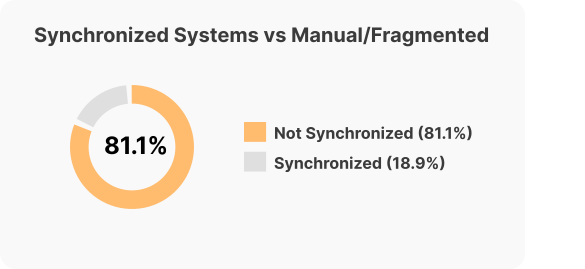
Without a controlled system, changes create downstream issues, including:
- Misalignment across systems: Recruiting, compensation, and HR systems don’t match. Differences may go unnoticed until they impact hiring or pay decisions.
- No version history: Teams can't easily track what changed, when it changed, or who approved it.
- Increased compliance risk: Inconsistent job definitions make it harder to demonstrate control during audits.
- Loss of trust in job data: Over time, teams stop relying on job descriptions as a source of truth.
Control Job Information at Its Source
Controlling job data is where most HR systems fall short. They store job data but don’t govern how it changes.
The difference comes down to one concept: a system of entry for job information.
What a System of Entry Solves
A system of entry creates a single point of control for job information.
It ensures that:
- Changes happen in one place
- Updates are versioned and tracked
- Approvals are consistent
- Data flows across connected systems
This is how you stop reconciling spreadsheets across HR, Total Rewards, and recruiting every time a role changes.
More importantly, it changes how decisions are made.
When your job data is structured, governed, and consistent, you can trust it.
The question shifts from, “Can we change this job?” to, "Can we trust what happens after we do?”
That’s the difference between flexibility and control, and why job information needs to be managed, not just edited.
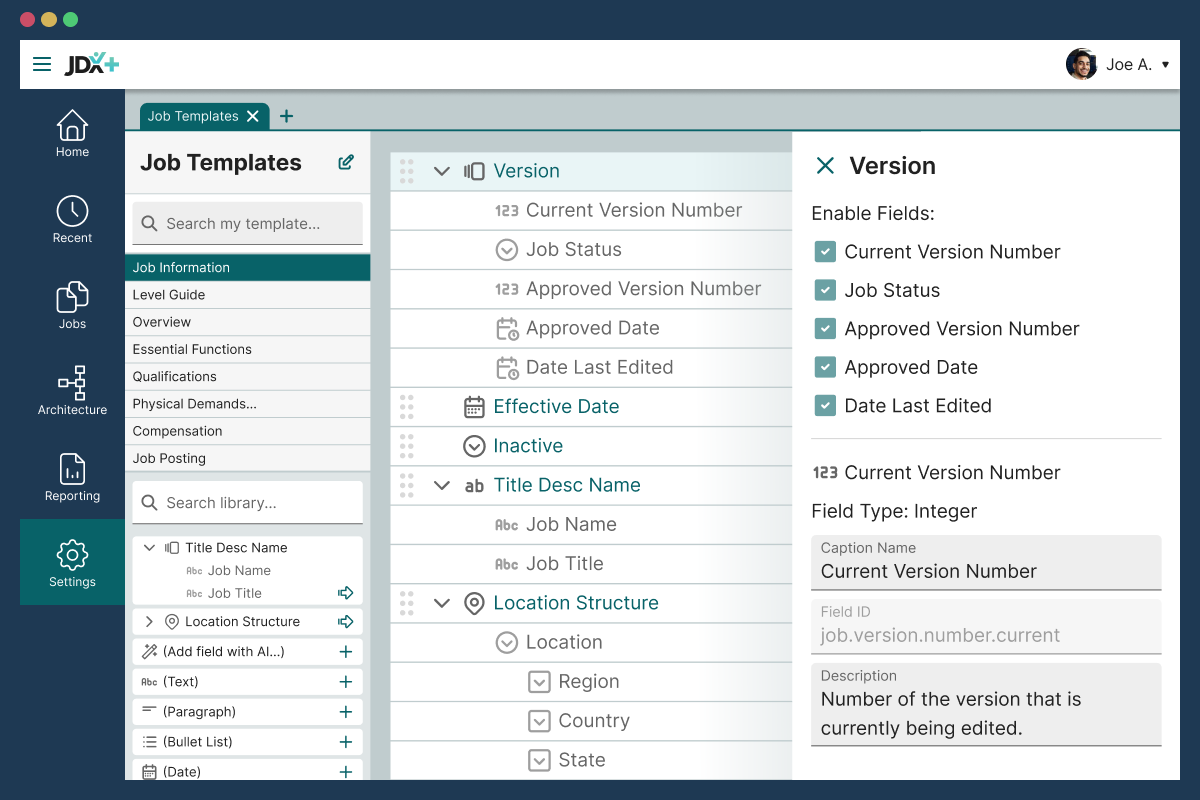
Use job templates as a governed foundation to enable consistent and compliant job descriptions.
Consider the Legal and Operational Implications
Most organizations believe they have flexible job structures. In reality, flexibility often creates fragility. That's also why it's worth understanding whether a job description is legally binding before you change one.
Even if you can legally change a job description, every uncontrolled change introduces variation. Over time, that variation leads to inconsistency, rework, and risk.
Ultimately, before making a change, you must understand if you can do so and how it impacts your downstream systems. By using a system of entry like JDX+, you can manage your job information in once place and extend its governance across the full job lifecycle.