

 Melissa Duncan, VP of People

Misclassifying an employee under the Fair Labor Standards Act (FLSA) is one of the easiest compliance mistakes to make, and one of the most expensive to fix. Back pay, liquidated damages, and penalties add up fast, and the exposure often spans years and multiple people at once.
Most of the confusion traces back to two stubborn myths:
- That every salaried employee is automatically exempt from overtime, and
- That a job’s title tells you its classification.
Neither is true. Exempt status depends on how much someone is paid, how they’re paid, and what they do.
Here’s how to get the classification right, and how to keep it right.
What “Exempt” and “Nonexempt” Mean
The terms come from the FLSA, the federal law that sets minimum wage and overtime standards. At its core the distinction is simple: nonexempt employees are entitled to overtime pay; exempt employees are not.
Here’s how the two compare:
|
Factor |
Nonexempt |
Exempt |
|
Overtime pay |
Yes — at least 1.5× regular rate for hours over 40/week |
Not eligible for overtime |
|
Minimum wage |
Yes — at least $7.25/hr (or higher state rate) |
Exempt from minimum wage rules |
|
Pay structure |
Paid for all hours worked, often on a more frequent schedule |
Fixed salary to get the job done, regardless of hours |
|
Meal/rest breaks |
May be required under state law |
Generally not required |
|
How the role qualifies |
Default classification if any exempt test fails |
Must pass all three: salary level + salary basis + duties (as outlined below) |
The Three Tests for Exempt Status
An employee has to clear all three of the tests below to be classified as exempt. Miss any one of them, and the role is nonexempt.
Test 1: The Salary Level Test
The employee must earn at least $684 per week—$35,568 per year—to be considered for exemption. Anyone paid below that threshold is nonexempt and owed overtime.
Why this number matters right now: The Department of Labor’s 2024 rule that would have raised the threshold (to $844/week, then $1,128/week) was vacated in court. On May 14, 2026, the DOL formally restored the 2019 levels, so $684/week is once again the operative federal figure.
It’s worth confirming, because many older resources—and plenty of older job descriptions—still cite the long-outdated $455/week.
There’s also a higher bar for highly compensated employees: those earning at least $107,432 per year can qualify for exemption under a lighter duties test.
Note that state thresholds can be higher. The federal number is the floor, not the ceiling. Several states—including California, New York, Washington, Alaska, and Maine—set exempt salary thresholds well above $684/week, and some tie them to a multiple of the state minimum wage that rises each year. When a state’s threshold is higher, you follow the more protective standard. If you employ people in more than one state, classify against each state’s rule.
Test 2: The Salary Basis Test
The employee must receive a predetermined amount of pay each period that doesn’t fluctuate with the quality or quantity of work. In other words, they receive their full salary in any week they perform work, regardless of hours. A few roles are treated differently: outside sales employees, doctors, lawyers, and teachers are exempt from the salary tests entirely, and certain computer professionals qualify if paid at least $27.63 per hour.
Test 3: The Duties Test
This is where title-based assumptions fall apart. A “manager” who doesn’t actually manage isn’t exempt, and relabeling a secretary an “administrative assistant” doesn’t change anything. What matters is the real, day-to-day work.
The most common exempt categories are:
- Executive: Regularly supervises two or more employees, has management as a primary duty, and has genuine input into hiring, firing, or promotion decisions.
- Learned professional: Work requiring advanced knowledge in a field like law, medicine, engineering, or accounting — typically gained through prolonged, specialized education.
- Creative professional: Work requiring invention, imagination, or talent in a recognized artistic or creative field, such as writing, design, or music.
- Administrative: Performs office or non-manual work directly related to business operations and exercises independent judgment on significant matters.
In every case, look at the tasks actually performed and how they affect your operations, not the job title.
Because the duties test turns on what a role actually does, your job descriptions are the primary record of it—which is one reason job descriptions can carry real legal weight. Documenting a role’s essential functions is also what makes it hold up for job description compliance, so the same discipline pays off across more than just overtime rules.
Common Misclassification Mistakes to Avoid
Even teams that know the rules tend to trip over the same handful of things:
- Assuming salaried means exempt. A salary is necessary but not sufficient—the duties test still has to pass.
- Classifying by title instead of duties. The role’s actual responsibilities govern, not what it’s called.
- Forgetting the state layer. A worker who is exempt federally may be nonexempt under a higher state threshold.
- Letting classifications go stale. When a role’s duties or pay change, its status can change too, but the paperwork rarely catches up.
- Rounding down the close calls. When it’s genuinely borderline, misclassifying as exempt is the more expensive bet.
Document Your Decisions and Get Them Signed
The single best protection against an FLSA claim is a clear, contemporaneous record of why you classified a role the way you did.
While no federal law strictly requires a written job description, a good one is your strongest documentation if a classification is ever challenged. “We reviewed the duties and here’s what we found” is a far stronger position than reconstructing the reasoning years after the fact.
Two habits make the difference:
- Write down the analysis. For each role, record the salary, the salary basis, and the specific duties that support the exemption, not just the conclusion.
- Get sign-off. Have the manager who knows the role confirm the duties are accurate, and route classification decisions through a consistent reviewer. A documented, signed-off decision is what turns a judgment call into a defensible one.
Build the Review into the Process
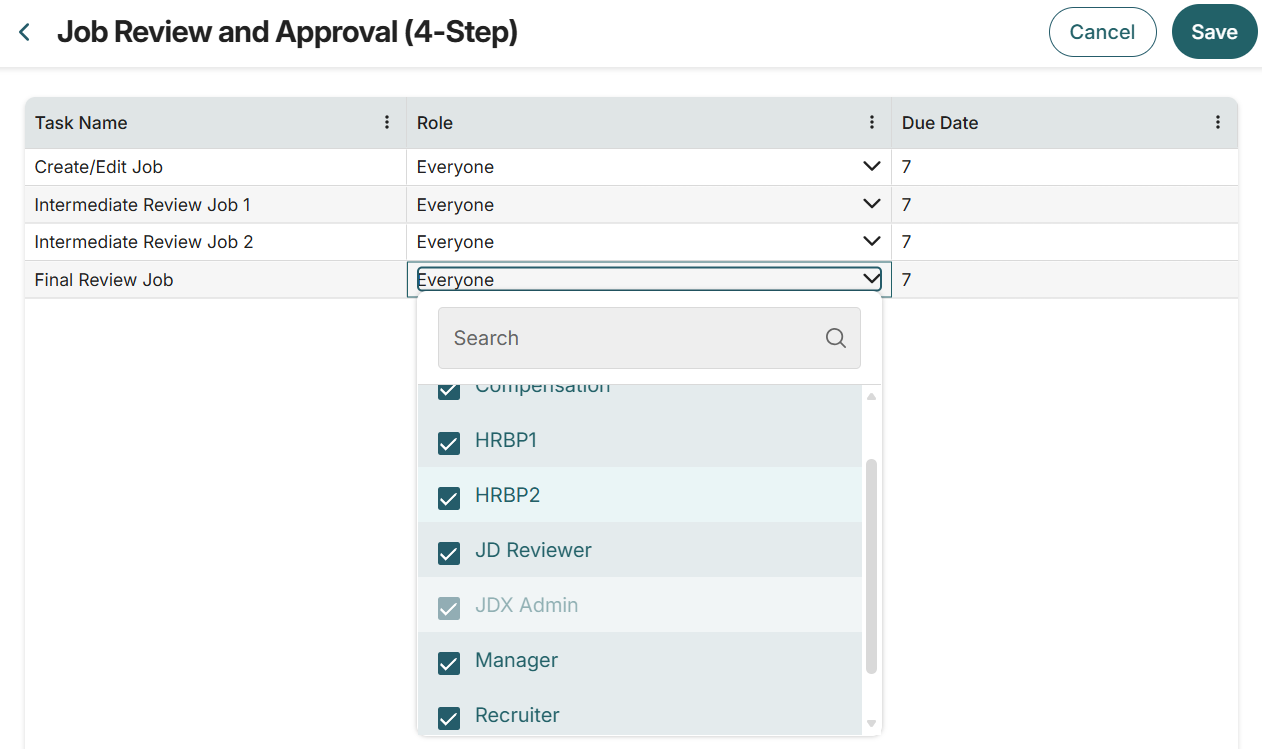
The safeguard against a missed or stale classification is making sure it doesn't rest on one person's call.
In JDX+, you can route a job through a structured approval workflow with up to six sign-offs — the hiring manager who knows the duties, a compensation analyst, HR, and whoever else should weigh in — so every classification is reviewed and recorded before it's final. If the role's pay or duties change later, it goes back through the same review instead of quietly drifting out of compliance.
One More Edge Case: Unpaid Interns
Interns raise a closely related question. Under the DOL’s “primary beneficiary” test, an unpaid internship is only lawful when the intern—not the employer—is the primary beneficiary of the arrangement. If an intern is really doing the work of a regular employee, they’re likely an employee under the FLSA and owed at least minimum wage and overtime. When in doubt, treat the role as nonexempt.
The Bottom Line
Classification isn’t a one-time filing; it’s an ongoing governance problem. Because roles evolve, pay changes, and thresholds shift, every type of drift is potential liability sitting quietly in your job data. The organizations that stay compliant are the ones that treat classification as something to document, review, and keep current, not something to settle once and forget.
Keeping FLSA status accurate and auditable across every job is exactly the kind of thing a job information platform is built to handle.