

 Melissa Duncan, VP of People

Job descriptions are often treated like administrative paperwork.
They get written during the hiring process, updated inconsistently, and buried in shared drives until someone suddenly needs them during a compensation review, accommodation request, or legal dispute.
That’s where problems start.
If your organization relies on job descriptions to support:
- hiring
- compensation
- compliance
- performance management
- or workforce planning,
those documents carry operational and legal significance whether you intended them to or not.
Are Job Descriptions Considered Legal Documents?
In most cases, no, a job description alone is typically not a legally binding employment contract.
But that doesn’t mean they lack legal weight.
In fact, job descriptions are frequently used as evidence in disputes involving wage classifications, disability accommodations, wrongful termination claims, pay equity reviews, and compliance investigations.
Legal risk is usually caused by having outdated, inconsistent, or poorly governed job descriptions.
Employment attorney Pavao Krmpotic, Managing Partner at Ladan & Krmpotic, considers job descriptions to be a foundational part of the employment relationship because they define the work employees are expected to perform and the responsibilities for which they are accountable.
“The job description should at all times correspond to the actual tasks the employee performs,” Krmpotic explains. “That means the employee is obliged to perform precisely those tasks for which they concluded the employment contract, for which they receive their salary, and for which they bear responsibility.”
He also cautions that while many employers include broad “other duties as assigned” language to maintain flexibility, relying too heavily on those clauses instead of updating documentation can create uncertainty around expectations, accountability, and compensation.
Specifically, job descriptions may help establish:
- the essential functions of a role
- required qualifications or certifications
- physical or scheduling requirements
- exempt vs. non-exempt classification rationale
- reporting relationships and responsibilities
- compensation expectations
- performance standards
Job Descriptions vs. Employment Contracts
Employers sometimes confuse job descriptions with formal employment agreements, but the two serve very different purposes.
|
Job Description |
Employment Contract |
|
- Defines duties and expectations |
- Defines legal employment terms |
|
- Often updated as work changes |
- Usually negotiated formally |
|
- Supports compensation, compliance, and workforce management |
- Establishes enforceable contractual obligations |
|
- May be referenced during disputes or investigations |
- Is itself legally enforceable |
|
- Often includes disclaimers |
- Usually contains binding legal language |
These distinctions matter because organizations rely on job descriptions operationally long before they become legally relevant.
For example, if an employee files a wage-and-hour claim under the Fair Labor Standards Act (FLSA), investigators may compare the documented responsibilities in the job description against the work the employee actually performs.
When those two things don't align, employers may struggle to defend classification decisions.
When Can a Job Description Become Legally Important?
Job descriptions become especially important when disputes arise around expectations, accommodations, compensation, or job scope.
Below are some of the most common examples.
Wage and Hour Classification Disputes
Employee classification remains one of the most common compliance risks employers face.
Under the FLSA, exempt and non-exempt classifications depend heavily on actual job duties. A vague or inflated job description can create exposure if it inaccurately portrays managerial authority or decision-making responsibilities.
For example, a company may classify an employee as exempt because the job description states they “manage strategic initiatives” or “exercise independent judgment.” But if the employee primarily performs administrative tasks with little authority, the documentation may undermine the employer’s defense.
The punchline: A job description should accurately reflect the work employees actually perform, not aspirational responsibilities copied from internet templates.
ADA Accommodation Requests
Job descriptions also play a central role in Americans with Disabilities Act (ADA) compliance.
When an employee requests a workplace accommodation, employers need to determine which duties are truly essential to the role. A well-maintained job description can help establish that framework.
As a reminder, employers are required to reasonably accommodate, modify, and/or adjust a job for a qualified individual with disability, making it possible for them to enjoy equal benefits and privileges of employment.
Without a clear job description, the employer is opening themselves up to risk over what the essential functions are and what the modifications can be.
Additionally, if teams rarely revisit and update job descriptions (meaning responsibilities evolve, but the documentation stays frozen), ambiguity and nuance are introduced during accommodation discussions.
The punchline: If the employer can't clearly identify the essential functions of a role, it becomes harder to evaluate accommodations consistently and defensibly.
Wrongful Termination Claims
Performance disputes frequently become documentation disputes.
If an employee claims they were terminated unfairly, job descriptions may be reviewed to determine whether expectations were communicated clearly and applied consistently.
For example:
- Were the stated responsibilities aligned with actual expectations?
- Did performance reviews evaluate duties listed in the job description?
- Were employees held accountable for responsibilities never formally documented?
According to McKinsey research, clear and accountable roles are one of the strongest drivers of organizational health and performance. When responsibilities are inconsistently documented across systems or departments, organizations create confusion not only operationally, but also during audits, compensation reviews, and employee disputes.
The punchline: The more inconsistency that exists between systems, managers, and documentation, the harder it becomes to demonstrate fairness and uniformity.
Pay Equity and Compensation Reviews
Job descriptions also influence compensation decisions more than many employers realize.
Teams use job content to:
- determine pay grades
- benchmark compensation
- map salary surveys
- define career levels
- support pay equity analyses
When similar jobs contain differing responsibilities, titles, or qualifications, compensation practices can drift over time.
That creates both operational and legal risk.
This is one reason many organizations are investing more heavily in standardized job architectures and better job data governance.
The punchline: If two employees perform similar work, but their job descriptions vary significantly, employers may struggle to defend compensation decisions during audits or investigations.
Why “Essential Functions” Matter Legally
One of the most important concepts in compliant job descriptions is the distinction between essential and nonessential duties.
The Equal Employment Opportunity Commission (EEOC) recognizes pre-hire job descriptions as supporting evidence when employers need to establish which job functions are essential.
That means employers should be able to answer questions like:
- Which duties are truly fundamental to the role?
- Which responsibilities are occasional or flexible?
- Does the role require physical presence?
- Are certain certifications legally required?
- Is travel actually necessary?
Too often, organizations include every possible responsibility in a long bullet list without identifying which duties are critical.
That approach creates confusion during:
- accommodation discussions
- return-to-work evaluations
- leave management decisions
- Joint Commission Audits
- workers’ compensation cases
Clear job descriptions help employers establish expectations while also supporting fair and consistent accommodation processes.
What Makes a Job Description Legally Risky?
Most legal exposure comes from inconsistency. Below are some of the most common problems employers create unintentionally.
Outdated Responsibilities
Roles evolve constantly, but job descriptions often do not.
Employees may inherit new systems, responsibilities, reporting relationships, or compliance obligations over time while documentation remains untouched for years.
That gap creates risk when organizations later rely on outdated job descriptions during disputes, audits, accommodation discussions, or compensation reviews.
That gap creates risk when the organization later relies on those descriptions during disputes or audits.
Inflated or Generic Language
Many job descriptions contain vague corporate language that says very little about the actual work involved.
Phrases like:
- “strategic leadership”
- “cross-functional ownership”
- “independent judgment”
may sound impressive, but they can create classification or expectation issues if they don’t reflect reality.
Clear, practical language is far more defensible than inflated terminology.
Requirements That Don’t Reflect the Actual Work
Job descriptions should focus on the work itself—not assumptions, inflated expectations, or outdated requirements that are no longer necessary for success in the role.
For example, organizations sometimes include:
- unnecessary physical requirements
- outdated degree requirements
- excessive years of experience
- responsibilities disconnected from the actual job
When requirements aren’t genuinely tied to essential job functions, employers create unnecessary compliance and legal exposure.
Clear, accurate documentation is better than broad or overly rigid requirements that managers can't consistently justify.
Fragmented Data Across Systems
This issue is becoming far more common in enterprise HR environments.
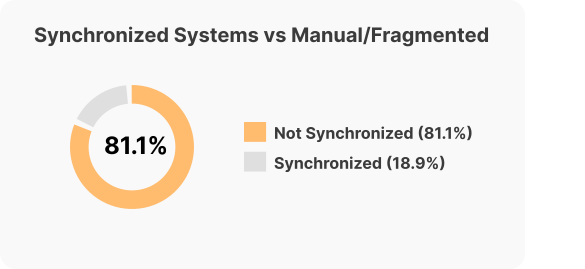 A job description may exist in:
- the HRIS
- ATS
- compensation platform
- internal career framework
- shared documents
- spreadsheets
- offer letters
When those versions conflict, organizations lose confidence in which source is authoritative, which can create operational headaches long before it becomes a legal issue.
How Employers Can Reduce Legal Risk
Strong job description management helps organizations reduce risk across compensation, compliance, accommodations, and workforce planning.
Here are four best practices employers should consider.
1. Standardize Templates
Standardized templates help organizations maintain consistency across job documentation, compensation practices, and compliance processes.
A governed structure ensures roles consistently capture:
- essential functions
- qualifications
- reporting relationships
- physical requirements
- compensation-related details
- approval history
That standardization becomes extremely valuable during audits, compensation reviews, accommodations discussions, and classification evaluations.
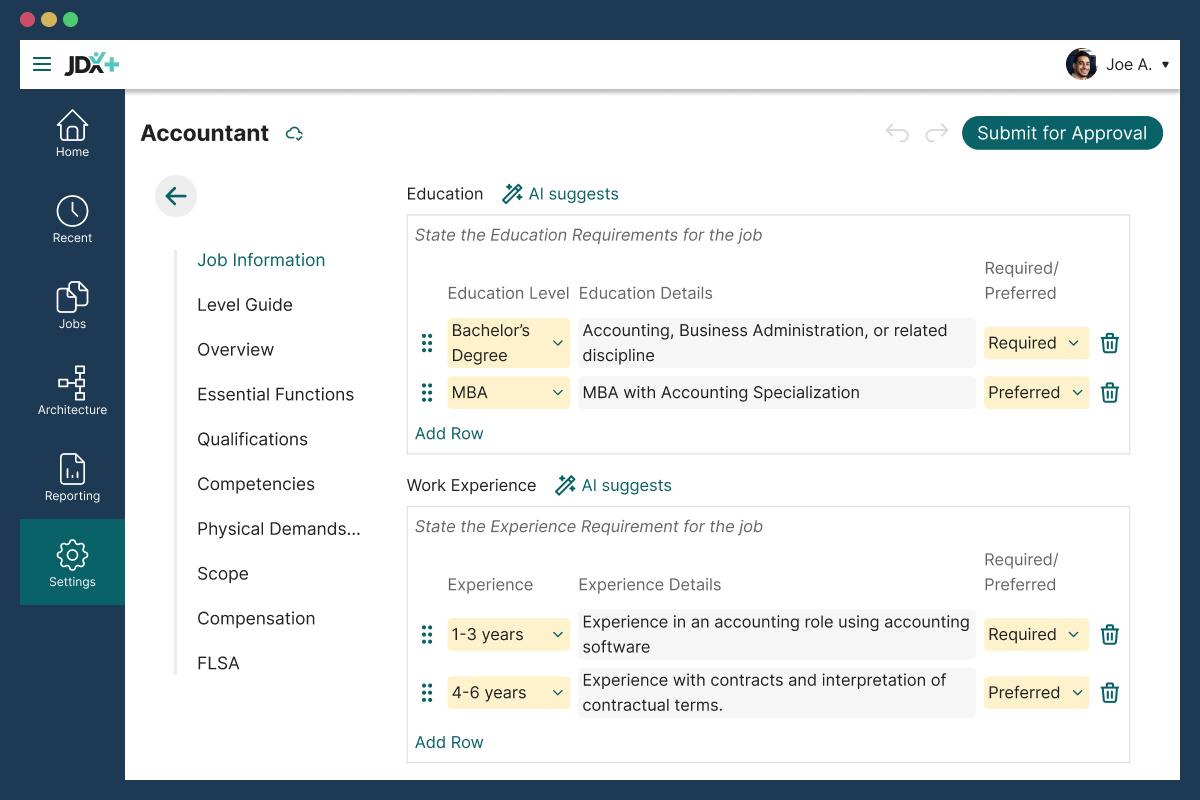
Standardized job templates make it easier to compare roles and ensure the essential functions and role responsibilities are aligned.
2. Establish Review and Approval Workflows
Job descriptions shouldn’t live in disconnected Word documents with no accountability.
Organizations should define:
- who can request changes
- who reviews updates
- who approves final versions
- how changes are documented
Governance matters because job data impacts multiple downstream systems and decisions.
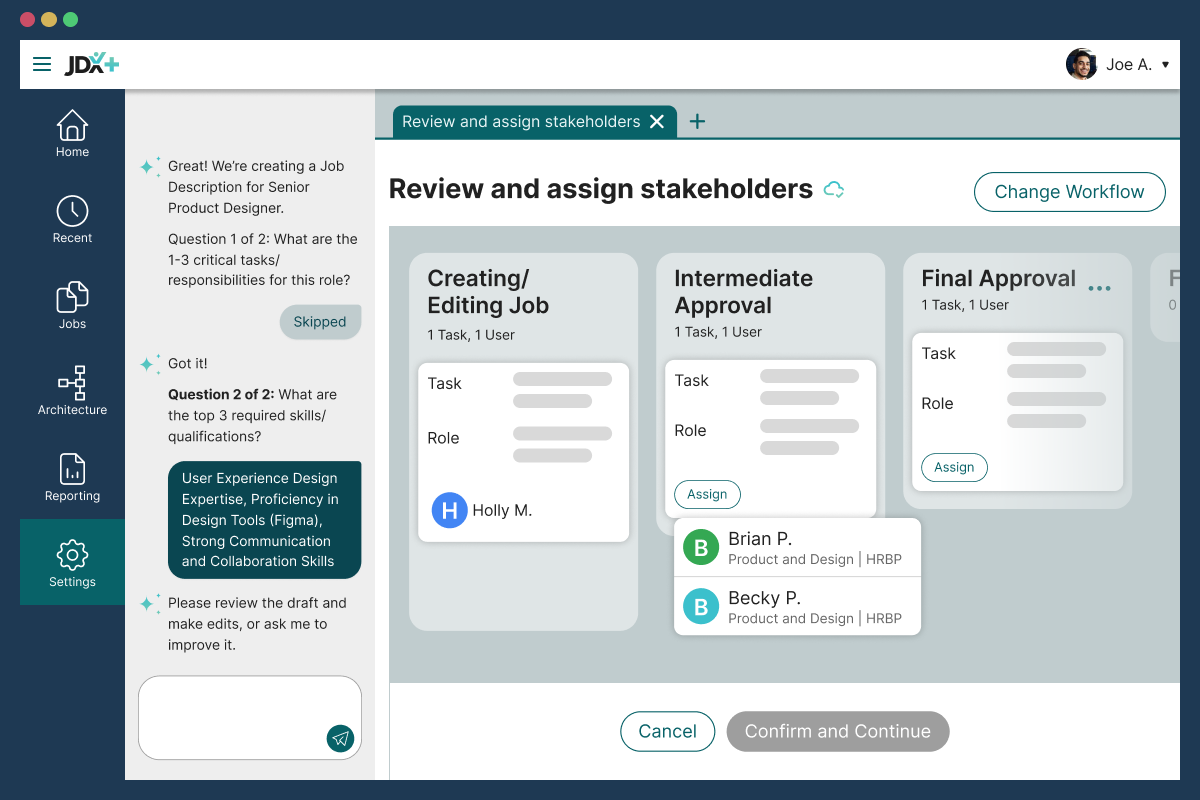
Predictable, policy-driven approval workflows help improve accountability and create greater transparency across teams.
3. Maintain Version History
A version-controlled audit trail can become extremely valuable during disputes or investigations.
Employers should be able to answer:
- When was this job updated?
- What changed?
- Who approved it?
- Which version was active at the time of the dispute?
Without that visibility, organizations often rely on scattered files and conflicting documentation.
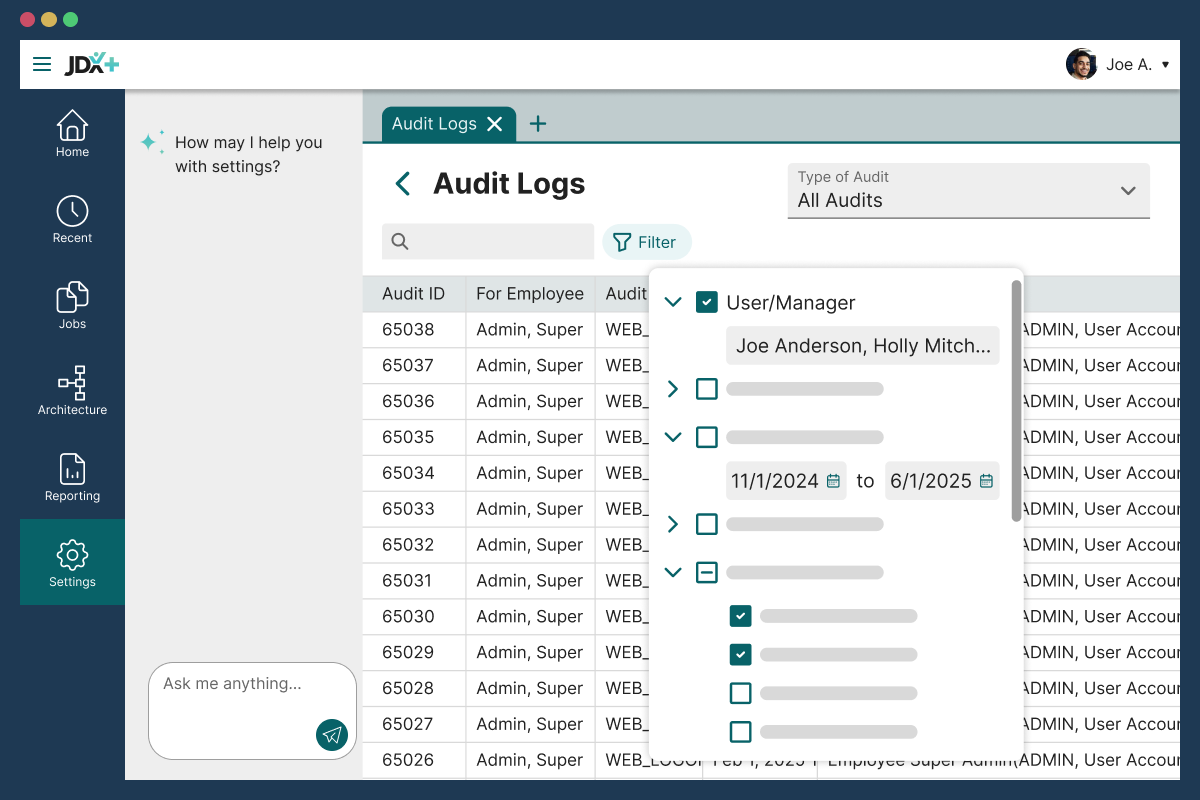
Audit trail reporting for job descriptions gives insight into workflows, publishing, and job library health.
4. Review Roles Regularly
Annual or biannual reviews help ensure job descriptions continue reflecting actual work.
This is especially important after:
- reorganizations
- acquisitions
- compensation redesigns
- technology changes
- return-to-office policy changes
- job architecture initiatives
Remember: Employees notice when job expectations evolve while documentation stays the same.
Related Questions Employers Ask About Job Descriptions
Legal enforceability is only one part of broader job description governance. Employers also commonly ask:
- Can employers change job descriptions without employee agreement?
- Are job descriptions confidential documents?
- How do compliant job descriptions support fair hiring and workforce practices?
As organizations rely more heavily on job data across HR systems, compensation programs, recruiting, and workforce planning, maintaining accurate and connected job information becomes increasingly important.
Final Thoughts
So, are job descriptions legally binding?
Usually not in the same way an employment contract is, but that doesn’t make them legally insignificant.
Job descriptions regularly become evidence in disputes, so when they're outdated or poorly governed, they create ambiguity that exposes organizations to unnecessary risk.
Leading organizations view job descriptions as operational infrastructure (instead of static documents) that support compliance, compensation alignment, workforce planning, and employee clarity.
When compensation, compliance, accommodations, and performance decisions all rely on accurate job information, poorly managed job data becomes a business risk—not just an HR problem.