

 Melissa Duncan, VP of People

Health systems rarely lack job descriptions. In fact, many have the opposite problem: they have variations (upon variations) of them, and struggle to determine which are current and which should’ve been archived in 2011.
HR leaders have told us that:
- their job content is housed "in three different places"
- their job descriptions live in "a very old format" that run over ten pages long
- "knowing which is the final blessed approved version can be tricky."
These problems come to light during most job description projects, but healthcare adds two complications that make job description management even harder to manually solve: roles that change by department, and credentialing that can’t be reported on.
Both start with where job content actually lives.
What an HRIS Stores and What It Leaves Out
The HRIS usually holds a job title, pay range, and job code, but not the job description itself. That surprises people because the system holds every employee, position, and job profile, so it’s fair to assume the description is in there, too.
It usually isn't, and the reason is architectural rather than accidental.
An HRIS is the system of record for people and the positions they occupy. Job content is a different object with a different lifecycle: it gets drafted, reviewed, approved, versioned and retired on a cycle that has nothing to do with hiring or payroll. Most HRIS platforms were never built to carry it, so what they hold is a shell.
Teams that write job descriptions in the HRIS anyway end up using whatever text field is available. A free-text box can hold a description, but it can't be compared across roles, reported on, or governed. In other words, the content exists but isn’t truly usable.
This is why sprawl survives an HRIS implementation. Our research found that 32% of HR teams report their HR systems don't sync, and 22% still house job descriptions in decentralized environments. The system of record for people is different than the system of entry for job information, and most organizations discover that gap after go-live.
.png?width=713&height=386&name=LinkedIn%20Image_%20Data_V01_Blue%20(1).png)
Why One RN Job Description Can't Cover Every RN
One job profile can't describe every RN because the role changes by department. Role variants exist everywhere, but clinical ones carry consequences most don't.
An RN in the emergency department and an RN in oncology share a title, a license, and most of a job description. They don’t share duties, unit-specific certifications, patient populations, or physical demands.
The org chart treats them as one job. The work treats them as several.
The Joint Commission's hospital requirements state that the organization defines staff qualifications specific to their job responsibilities. This means that, where responsibilities genuinely differ by unit, one shared profile can't define the qualifications for both.
Most HRIS configurations force a choice between those two truths, and neither branch is good.
- You can either create one RN job profile and lose everything department-specific, or
- You can create dozens of near-duplicate profiles and lose any ability to update them together.
Health systems usually end up with both: one generic profile in the HRIS, plus a scatter of department-level documents maintained by whoever had time.
The structural answer is a parent-child relationship, where a core RN definition holds everything common to the role and each departmental variant inherits from it. Update the parent and the change cascades down to every child.
Parent-child structures aren’t just for nursing positions; social work, respiratory therapy, and rehabilitation have the same shape, as does any role where the title is stable and the unit changes what the job involves.
Why You Can't Currently Report on Credentialing Requirements
Certification requirements usually live inside the text of a job description, which means they can't be queried across the organization. In most industries that's tolerable, because the requirements are stable and few.
Healthcare licensure is neither. Consider what "requires an RN license" actually means once you look at it properly. The Nurse Licensure Compact now covers 43 jurisdictions, but a multistate license doesn't flatten the problem:
- The state a nurse is practicing in follows where the patient is located, not where the nurse sits. Telehealth into a non-compact state requires a single-state license there.
- Each state's Nurse Practice Act still applies wherever care is delivered.
- Continuing-education obligations are owed to the home state, and non-compact states may impose their own on top.
- A nurse who changes primary state of residence has 60 days to apply for a multistate license in the new state.
None of that is unusually hard to write into a document. The difficulty arrives when somebody needs to answer a question across hundreds of them — which roles require BLS, which carry a license that expires inside ninety days, and which are affected if a state leaves or joins the compact.
The Joint Commission's standards FAQ states that when specific minimum requirements are written into a job description, the organization must verify and document that the individual holds them. The example given is a Nurse Manager job description requiring a Master's in Nursing: once that's in the document, it must be confirmed. Those standards also apply to contract staff providing patient care, not just employees.
That obligation isn’t unique to the Joint Commission. Health plans accredit under URAC or NCQA, and tissue and transplant organizations answer to the FDA and AATB. The accreditor changes with the kind of organization; the need to show that documentation matches the work doesn’t.
The bottom line: The job description isn't a passive record. Writing a requirement into it creates a verification obligation, and if the requirement is buried in prose across several hundred documents in no consistent place, the obligation is real while the ability to track it isn't.
What Governed Job Information Looks Like
A template is the right starting point, but it won’t hold on its own. Without required fields and an approval path behind it, “standard” becomes “suggested,” and you’re back in the same position within three years.
What holds it in place is four things working together:
- One place job content is authored. Not the HRIS, which stores the shell, and not a shared drive. A system of entry that the HRIS consumes.
- Parent-child structure for role families. So RN, respiratory therapist and social worker variants inherit a common core and carry their own differences.
- Requirements as fields, not sentences. Licenses, certifications and renewal windows that can be reported on across the organization.
- Version history and approvals. So "which one is the final blessed approved version" has an answer that doesn't require anyone to dig.
Cadence matters as much as structure. SHRM's guidance puts an annual review at the minimum, with the caveat that a job which has changed shouldn't wait for the annual cycle to be corrected.
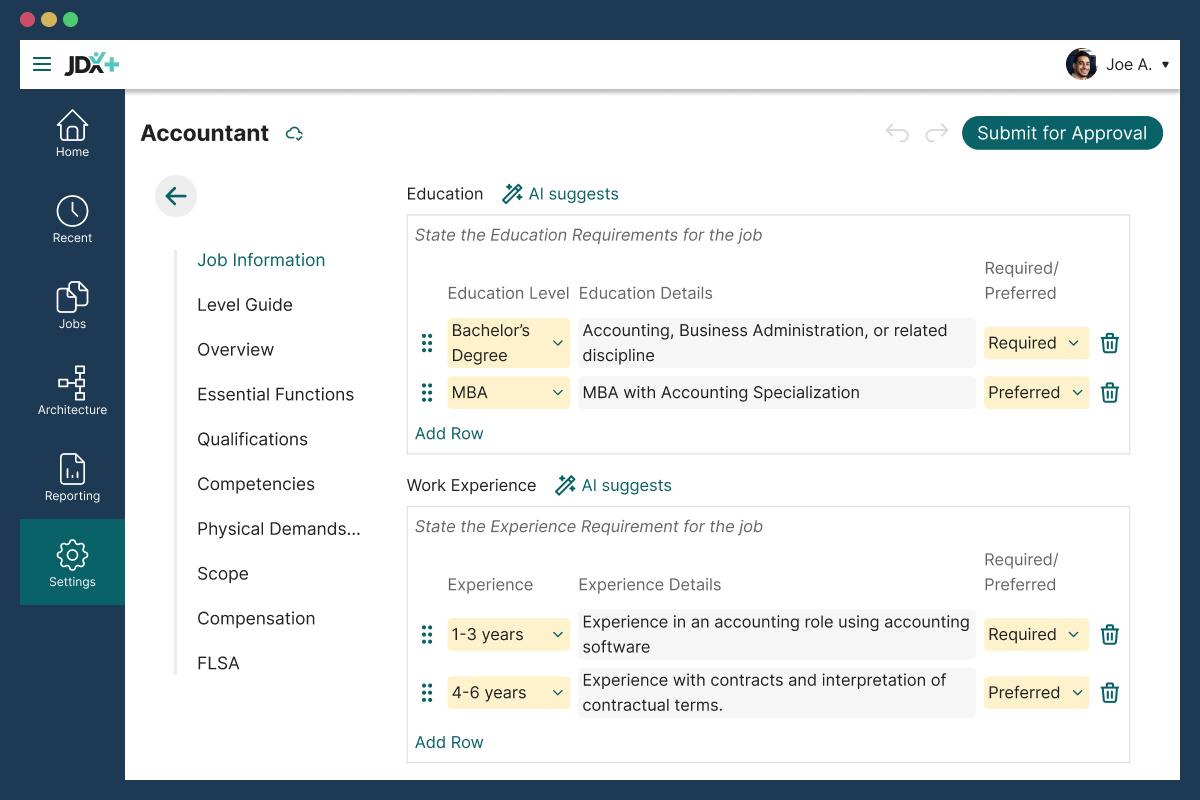
Standardized job templates with best-practice fields allow you to configure once and reuse everywhere.
Where JDXpert Fits
JDXpert is a Job Information Management Platform — the system of entry for job information, sitting upstream of the HRIS rather than inside it. What it governs is the job description itself: how it's written, what it must contain, who approved it, and which version is in force.
In a health system, that comes down to five things:
- Standardized templates with required fields. Every description captures essential functions, licensure, certifications, and physical demands because the template requires them, not because the person writing it remembered.
- Parent-child job descriptions. A core RN description holds what's common to the role, and each departmental variant inherits it while carrying its own duties, certifications, and physical requirements. Update the parent and the change cascades to every child.
- Credentialing as structured data. Licenses, certifications, and renewal windows live in fields rather than paragraphs, so "which roles require BLS" becomes a question you can run rather than a search you have to conduct.
- Version history and approvals. Every change is attributed and time-stamped, so producing the version an employee held three years ago takes a minute.
- Employee acknowledgements. Staff sign the current version of their description, and the record is version-aware — which is what a surveyor is asking for when they want to know whether someone signed the description that's in force today.
Job content is authored once, then synchronized outward to the HRIS, recruiting, and compensation, so the same definitions reach every system that acts on them.