


 Melissa Duncan, VP of People

When someone in HR describes a role as “nuanced,” they’re often pointing to accumulated context — scope differences, leveling decisions, and responsibilities that evolved over time without ever being formally standardized.
Your team may understand those distinctions informally, but your systems and data usually don’t.
At first glance, this issue seems minor. Over time, it becomes organizationally significant.
That’s because job descriptions shape how roles are leveled, priced, compared, and progressed across the organization.
When those reference points are loosely defined, the decisions built on top of them become harder to explain and harder to trust.
What HR Calls “Nuance” Is Often Unstructured Job Data
Most organizations don’t actually have a nuance problem. They have a definition problem.
What organizations often call “nuance” usually comes from four things:
- Roles evolving faster than documentation: Teams scale at different speeds, your to-list gets longer, and “I’ll fix it later” never happens.
- Managers defining similar work in different ways: Leaders describe responsibilities in their own words. Titles get reused across departments with entirely different expectations attached.
- Institutional knowledge living in people instead of systems: Leaders can’t apply organizational context (and make fair decisions) if it’s never formally defined.
- Responsibilities bleed into new roles: Employees get promoted but keep part of their old responsibilities, too. No clean break = inconsistent expectations and accountability.
Over time, two roles with the same title end up carrying different levels of scope, responsibility, and impact, and the only people who understand the difference are the HR leaders who have been around long enough to remember why.
That institutional knowledge feels like nuance, but it’s not.
It’s structure that exists informally through conversations rather than through shared definitions. Without clear job families, level expectations, and standardized language, those differences live in interpretation.
With new managers, new HRBPs, a reorganization, a leadership change come interpretation shifts, and nobody notices until something breaks.
Why Informal Role Definitions Stop Working at Scale
In smaller organizations, informal knowledge accumulated over time can carry the weight. HR leaders and managers are close enough to the work that they understand the differences between roles without needing every distinction formally documented.
As organizations grow, that approach quietly stops working because:
- The number of roles increases
- New teams, regions, and leaders introduce different interpretations
- Employees move between departments that describe similar work in completely different ways
What once felt manageable starts becoming fragmented because the system simply outgrew the informal agreements holding it together.
That gap becomes much more visible once AI enters the process.
LLMs can generate a job description that looks polished, complete, and aligned with industry standards. But when ChatGPT or Claude drafts multiple versions of the same role, each version can reflect a different interpretation of that role in practice.
Without shared structure underneath, that volume turns into variation.
How to Tell If This Is a Problem in Your Organization
Many organizations already see signs of this issue, even if it hasn’t been labeled clearly. They usually appear operationally before anyone identifies the structural issue underneath.
You may be seeing this dynamic if:
- similar roles are leveled differently across teams
- compensation discussions require significant manual reconciliation
- job descriptions vary widely in format, language, or depth
- internal mobility slows because comparable roles are difficult to identify
- managers rely heavily on HR to interpret role differences
- employees question why similar roles appear to operate under different expectations
These aren’t isolated operational issues. Instead, they’re indicators that job data is being interpreted rather than consistently defined.
Once interpretation becomes your operating model, organizational alignment becomes dependent on who happens to be involved in the decision.
How Undefined Roles Affect Compensation, Leveling, and Mobility
The real consequences emerge later, once your role definitions begin shaping compensation, leveling, hiring, and mobility decisions across the organization.
Once you skip the hard work of defining roles clearly, you don't just create confusion; you create the conditions for inequitable pay, inconsistent leveling, and career paths that go nowhere.
An early-stage shortcut becomes one of the most expensive organizational debts you'll carry.
When roles aren’t clearly and consistently defined, teams begin to see patterns like:
- compensation comparisons that are difficult to justify
- leveling decisions that rely on interpretation instead of structure
- slower internal mobility because roles are not easily comparable
- new roles that don’t fit within existing job frameworks
At that point, the issue is no longer about data quality. It’s about decision quality and how those decisions differ across teams. In some cases, that variation introduces compliance risk. In others, it creates bias that is difficult to detect or explain.
Moreover, conflicting decisions impact company culture.
When employees see these gaps and the unpredictability of decisions, they start asking:
- Why is that role leveled higher than mine?
- How did that team define their scope differently?
- What do I need to accomplish to move up?
Over time, this creates a manager-dependent environment that may feel political, even when the intent is fairness.
Why Most Organizations Already Struggle with Job Data
What makes this harder is that most organizations were already operating with fragmented job data long before AI entered the picture.
As Thomas Redman, advisor and president of Data Quality Solutions, puts it, “Most companies’ data foundations are pretty creaky and are getting creakier by the day. The data are scattered and poorly defined, and it’s difficult to connect different sources.”
This dynamic is already well established in HR. Teams spend time reconciling job data across systems, aligning role definitions, and correcting issues after they surface during compensation reviews or hiring decisions.
Recent data reflects the same reality: Nearly half of HR leaders say they don't fully trust their job and skills data. When the underlying data isn’t trusted, the decisions built on top of it become harder to defend.
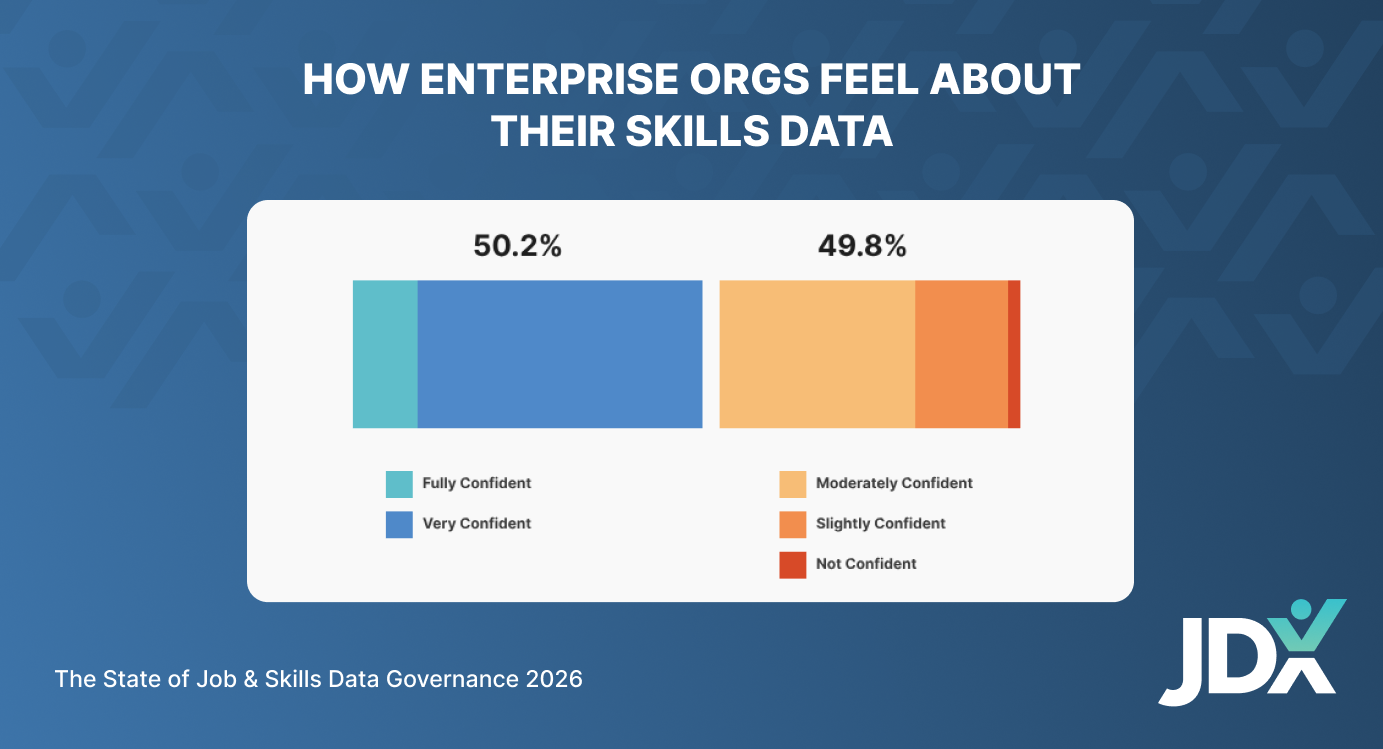
AI-generated content doesn’t remove that reconciliation work. Instead, it increases the volume of inputs that need to be aligned. The underlying issue — unclear and inconsistently defined structure — remains the same.
What It Takes to Define Roles More Consistently
If nuance is going to scale, it needs to be embedded in how job data is structured and managed.
That starts with clarity around the fundamentals:
- Define job families and levels in a way that is consistent across the organization
- Establish clear expectations for scope, responsibility, and impact at each level
- Standardize how roles are described so they can be compared reliably
- Align job definitions with compensation frameworks and career progression
When organizations define work more clearly, managers make decisions against shared expectations and HR teams spend less time reconciling interpretation gaps.
Once structure exists, every tool in the stack — including AI — becomes more useful because it's operating against shared definitions instead of disconnected assumptions.
A bonus: Employees gain confidence that decisions are grounded in something larger than individual interpretation.
The Bottom Line
Nuance isn't the problem. Nuance that lives in people’s heads instead of in the system is the problem.
AI makes this visible faster than it used to be. But the gap was always there, living between what organizations know informally about their roles and what's actually defined, documented, and defensible.
The teams that close that gap will make faster decisions, build more trust with employees, and create more consistency across the business without losing flexibility.
The ones that don’t will keep managing the same ambiguity, one exception at a time.